 Call us
 Email us
Art Forgeries: Ways Art Forgers Fool Collectors
Related Articles:
Fake Artist Signatures on Prints
Art Fraud on eBay
How Criminals Make Big Money Selling Fake Art on eBay
Art Picks from eBay
Q: Could you please review some of the methods forgers use to alter works of art? Are signature databases, dictionaries or directories good for comparing signatures and spotting problems? I sometimes see art I like for sale online or at small auctions, antique shops and collectives, but am reluctant to buy because I'm not absolutely sure it's authentic.
A: You show good judgment by hesitating. Forgers are at least as much of a problem at small auctions and retail shops as they are at the major sales, and they're a major problem online. They also seem to make about as much progress at fooling people as forgery detectives make at foiling their efforts; keeping up with how they manipulate or alter art is a constant battle. Even though fakes represent only a small percentage of all available art, unless you know exactly what you're doing and what you're looking at or a seller provides indisputable proof of authenticity, you can be taken advantage of.
To complicate matters these days, you also need proof that any art you're interested in buying hasn't been stolen. Once again, the great majority of art is in the possession of its rightful owners, but under certain circumstances, if you get caught with stolen art, you are financially responsible for it's return, not necessarily the party who sold it to you. Laws and statutes vary from state to state and country to country on this so if you have any questions, make sure to consult with an attorney and get informed about what the situation is where you live and do business. Also be aware of websites like IFAR, the International Foundation for Art Research. They maintain a stolen art database; you can always check with them if you have suspicions (or just to be on the safe side). Interpol also maintains a database of stolen art.
Your best protection against forgeries is knowing what art by the artists you collect or want to buy looks like-- back, front, top, bottom, sides, everything. People who get fooled are often only familiar with artists' names and not much else, including the subtleties of those artists' signatures. Here's a partial list of what you need to know about an artist and their art before you buy, especially if you're beating the bushes for their art at places that do not represent or regularly handle the artist. The best way to learn these things is by looking at plenty of examples of their art, and speaking with dealers, collectors, specialists or recognized authorities on those artists:
* What their brush strokes look like.
* What their favorite subject matters and compositions are.
* Where they typically sign on their art.
* What colors and mediums they sign in.
* How they sign (full name, initials, first initial & full last name, etc).
* What mediums, materials, sizes and formats they usually work in (for example, how they attach their canvases to stretcher bars).
* What the art looks like from the back (experts can often tell more from the back than they can from the front-- examining the backs is essential).
* How it's usually framed, mounted, or displayed.
* If, how or where it's usually titled, dated or numbered.
* What gallery, manufacturer, or supplier tags or labels it's likely to have.
* What the bottom looks like if it's a sculpture.
Once you get experience examining multiple works of art by particular artists in a comprehensive way, you begin to realize that every artist's style is pretty much unique-- almost like fingerprints-- and for forgers, there's almost always too much for them to duplicate in order to fool the best experts. It's hard to slip a fake past someone who knows exactly what they're looking at how to analyze it.
As for examination techniques, black light has traditionally been used to detect irregularities on paintings, but recent advances by forgers have made this more and more difficult. Newly added signatures or recent restorations on older paintings tend to floresce and appear to float above painted surfaces when viewed under black light, for example, but non-flourescing paints are sometimes used to counter this effect. Masking varnishes that impart overall translucent greenish looks to surfaces are also being used to hide signature inconsistencies or restorations. For example, if the varnish on a painting has an overall greenish translucent look, that might be a sign to exercise caution before buying. Black light is still worth using, however. Under normal circumstances, it can still show previous restorations or floating signatures and gives other clues, positive as well as negative, to a painting's past.
A good jeweler's lupe or 60-100 power illuminated pocket microscope (widely available online for under $20) can be helpful in trying to figure out whether a limited edition print or work on paper is genuine or a digital copy. Digital camera microscopes that project magnified images onto your computer screen are also available. Computer printing processes have become so sophisticated that they can accurately duplicate etchings, lithographs and similar traditional printing techniques. Learning how to tell the difference between digital reproductions and traditional printing techniques when viewed under magnification is a skill that's definitely worth learning. Magnification tools can also be used to identify locations on a painting where newly added paint has bled into nearby hairline age cracks. For example, if paint from a signature appears to run into the microscopic cracks directly beneath it, that could mean that the original surface paint dried, aged and cracked long before the signature was added.
Another huge problem these days has become hand-painted copies, particularly from China. All kinds of websites now advertise that they can paint accurate reproductions of whatever art by whatever artist you want. And some of these copies are so good that at a glance they appear indistinguishable from the originals. Now if you know what every single detail of an artist's art looks like, from the brushstrokes to the materials they normally use, you're well-prepared to spot copies. But if you don't, watch out!
Other suspicious details that could indicate a possible forgery or doctoring:
* Old frames are sometimes cut down and placed on fake paintings to enhance their original antique looks. (Check to see whether corner joints match the age on an older frame or look fresh and recently cut). New frames manufactured in old styles can also be made to look antique with aging techniques such as staining, spraying or otherwise artificially aging the backs.
* Paper, either new or old, that's glued over a painting's back. This is sometimes done to hide inconsistencies, condition problems or other manipulations. The back of a painting is as important as the front (sometimes even more so). Always inspect a painting from the back before buying-- and learn what to look for when you do. If it's been papered over, ask the seller to remove it. If they refuse, then maybe you should refuse too.
* Sometimes art is accompanied by certificates of authenticity, appraisals or other documentation. But those can also be faked, so you have to know how to tell the difference there as well. To learn more about how to spot and identify problems with COAs and other forms of documentation, read Is Your Certificate of Authenticity Worth the Paper It's Printed On?.
* As mentioned above, make sure you're not buying a digital copy or reproduction of an original or limited edition print. Mere visual inspection-- especially if the print is under glass-- is not always enough. You not only have to know what technique was used to print or create the original or original edition and how to recognize it, but also what paper it was printed on, what the print looks like under magnification, how large the margins are supposed to be, if or where it's supposed to be signed or dated or numbered, and other particulars.
* Watch out for cleanly cut edges on a canvas or artist's board that have no overhanging paint or primer along those edges. This may mean the art has been cut down from its original size, thereby reducing its value and desirability to collectors. A very clean paint or cut line along edges might also mean that some kind of mechanical reproductive process has been used either in full or in part to create the image.
* Old nail or mounting marks on the back of an artist's board or stretcher bars may mean a painting has been removed, doctored and then replaced into either its original frame or a different one. You can usually see marks where nails have been pulled and then replaced.
* Beware of new stretcher bars on old canvases. Restorers legitimately use new stretcher bars when old ones can no longer support a weak or damaged canvas, but forgers may also use them to help obscure or alter a painting's identity.
* On graphics, watercolors and other works on paper, watch out for signatures that look fresher, bolder or otherwise inconsistent with the art itself. Shaky or rigid signatures rather than smooth spontaneous ones are sometimes a giveaway as well. Pencil or ink signatures on a watercolor might also be cause for concern, especially if the artist usually signs in watercolor.
* Be cautious when you find labels, news stories or artist biographies that have been recently glued onto the backs of unsigned works of art-- unless you're positive they're as old as the art itself. No matter how good these additions look, how convincing they are, or how important the artists may be, remember the art is still unsigned.
* Watch for signs that a new painting has been recently "aged" to look old. For example, stretcher bars might be sprayed with stains to make the wood look older, old stickers might be added to the backs, either the frames, artist's board or stretcher bars; paintings might be surfaced with yellow-toned varnishes to make them look antique, and sometimes even fake "dust" is added by more enterprising criminals.
* Hearsay or gossip that an unsigned work is by a particular artist is just that-- heresay. For example, if a seller tells you, "The owner told me that this has been in his family for 100 years and was painted by Vincent Picasso," that means absolutely nothing. If they seller says it came from an estate of the wealthiest person in town who lived at the top of the highest hill, that means absolutely nothing. You need concrete indisputable proof of ownership history and/or authenticity in order to follow up on any claims that seller's make.
As for artist signature encyclopedias, directories and online examples or databases, they do not necessarily protect you against forgers. First of all, an artist's signature can change throughout the course of his or her career. Secondly, a forger can use the same signature directory or website or image to learn how to fake the exact same example you're looking at in order to identify it. Thirdly, attempting to determine authenticity by examining only the signature while ignoring the rest of the art is one of the easiest ways to get stuck with a fake.
Remember-- if you're not all that familiar with the physical characteristics of an artist's art, consult a professional or similarly qualified expert if you have questions whatsoever. AND DO IT BEFORE YOU BUY, NOT AFTER. As for improving your ability to detect forgeries, study as many authentic examples as possible firsthand, not from illustrations or images online, get to know what they look like in every respect, learn from experienced professionals how they detect forgeries, see as many fakes as possible and have experts explain why they're fake, and train your eye by regularly inspecting art under professional supervision.
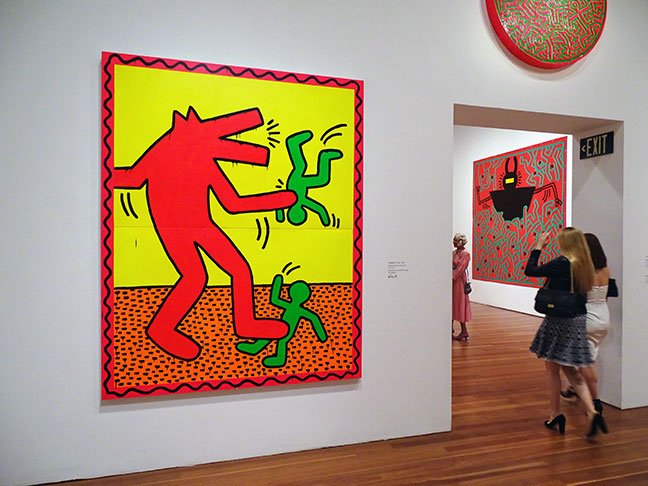
(art by Keith Haring at the de Young Museum, San Francisco)

Current Features
- How to Buy Art on Instagram and Facebook
More and more people are buying more and more art online all the time, not only from artist websites or online stores, but perhaps even more so, on social media ... - Collect Art Like a Pro
In order to collect art intelligently, you have to master two basic skills. The first is being able to... - San Francisco Art Galleries >>