 Call us
 Email us
Common Misconceptions People Have
About Art Galleries and Buying Art
The purpose of the following list is to help increase the overall understanding of anyone who has an interest in art (especially collectors, buyers and even artists) about how the art gallery world works, how art is viewed in terms of value, how to approach and interact with galleries and others who sell art, how to optimize transactions involving art, and most importantly, to clarify that there are many reasons to own original art other than simply financial ones. The better you comprehend the art world's ways, the more rewarding your experiences and involvement with art will be.
Misconception: Art gallery owners live lives of unlimited fun and partying, and hardly ever work.
Reality: People are often attracted to the art world based on fantasies like these, experiencing only the pristine calm and refinement of gallery settings or lively art parties and show openings when in fact, selling art is a business like any other, and in many ways, a more difficult business than most. Why? Because selling a commodity that serves no practical purpose, has no quantifiable tangible value, and that no one really needs in order to survive is challenging to say the least. Owning art has numerous benefits, of course, but they're not necessarily obvious or easy to explain.
Significant expense is involved in maintaining galleries, many of which exhibit less than 20 works of art at any given time. From a strict business standpoint, this is not exactly an effective use of space, but in terms of aesthetics, galleries do their absolute best to help people understand and appreciate just how good art can look. Given these circumstances, gallery owners are required to work extra hard-- all day every day and often well into the night-- to sell enough art to survive and stay in business. Contrary to popular belief, galleries are not museums or party central and are not in existence for recreational and entertainment purposes only. If you like art you see at a particular gallery, understand that your patronization is what keeps them in business, thereby enabling you to continually experience all they have to offer. If you're an artist who shows at a gallery, be patient; they're trying their best to sell your art.
Misconception: Art galleries make lots of money.
Reality: No.
Misconception: Art is an investment that increases in value over time.
Reality: Yes art is an investment, not from a monetary perspective but rather as an investment in your quality of life. As to whether art appreciates in value over time, some does and some doesn't. What always appreciates though is the satisfaction and enjoyment you'll take in owning it, assuming you didn't buy it for money reasons alone. There is no better way to compromise the enjoyment of owning art than to base that enjoyment on what it may or may not be worth at any given point in time.
Misconception: Art is worth owning mainly because it has the potential to increase in value.
Reality: False. The creation of art is an endeavor that's beyond material considerations. It's about inspiration, innovation, imagination, discovery, investigation, courage, acceptance, tolerance, unconventionality, exploration, inquiry, contemplation, reflection, understanding, open-mindedness, freedom of expression, freedom to experiment without having to worry about traditional rules or constraints, and all kinds of other great stuff like that. Being exposed to the realm and results of pure creativity can only have positive effects on the rest of your life. Art has the potential to elevate and even transform the way you think, see and relate to the world... if you let it.
Misconception: Art galleries can sell or resell art quickly and easily with little or no effort. Art is liquid like currency.
Reality: Not even close. There is no place you can go to simply "cash art in." Art is more like real estate in terms of liquidity. In the same way you put your house on the market, you put your art on the market and hope at some point the perfect person comes along and buys it. Galleries show art they believe the public deserves to see and that people will hopefully be interested in owning. They're not about turnover (even though turnover keeps them in business); they're about art. As with real estate, sometimes their art sells instantly; sometimes it languishes unsold for months or even longer. But that's OK because they believe in it. If you're buying art to flip for profit at some later date, and your primary motivation is to make money, you're likely in for an unpleasant awakening at some point down the road.
Misconception: Art is an asset class.
Reality: Not really. Back in the good old days, like say forty years ago, art was just art. Then one day, some enterprising gallery somewhere began referring to it as investment. Within perhaps the past five years or so, the art-as-investment cabal has upped the ante and christened it an asset class. To quote from investorwords.com, an asset is defined as follows: "Any item of economic value owned by an individual or corporation, especially that which could be converted to cash. Examples are cash, securities, accounts receivable, inventory, office equipment, real estate, a car, and other property." To repeat, unlike the commodities just mentioned, there is no place you can go to simply "cash art in." The difficulty with considering art as an asset class arises in attempting to demonstrate with actual concrete facts and proof that it has cash value based on measurable quantifiable tangible qualities and characteristics.
Proving that $100 worth of paint arranged in a certain way on $300 worth of stretched canvas is worth one million dollars is a tall order indeed. It may well be worth one million dollars, but only in the minds of those who say it is and those who believe it is, and only for as long as they continue to believe it. In addition, that piece of art is salable only in highly specialized markets to only a minute percentage of the population and only under very specific and ideal conditions, not in all markets everywhere and anytime like say gold, oil, equities or regularly traded commodities with demonstrable tangible value. Art as an asset class? You have got to be kidding!
Misconception: Art at galleries is too expensive. Galleries are places to learn about art and artists in order to buy it cheaper elsewhere.
Reality: You get what you pay for. Beating the bushes for bargains can be a very risky business. On the flip side, advantages of buying art at galleries are that they vet every single piece of art they sell, they are extremely knowledgeable and well-informed about the art they sell, they know the difference between good art and bad art, they offer amenities that auctions or private parties or other non-gallery venues don't, they often have access to art that many buyers and collectors don't, they stand behind every work of art they sell (as opposed to buyer-beware venues like auctions or private sellers), and more, some of which you'll read about below.
Misconception: Just like gallery owners and other art professionals, anyone can tell the difference between good art and bad art regardless of how much they know or have seen.
Reality: No way. People are not born with innate abilities to recognize quality and significance in art. Acquiring a discerning eye takes time, education, training and practice. Hardly anything beats looking at and discussing art firsthand with experienced art world professionals like gallery owners. Galleries are great places to learn how to look at, appreciate and evaluate art; cultivating these skills is essential for anyone who's serious about art.
Misconception: People deserve the undivided attention of gallery owners whenever they feel they need it. Calling ahead or making appointments is not necessary. Nor is calling or contacting them repeatedly with various requests.
Reality: Gallery owners often have to take care of multiple agenda items at once. Unless you're a major collector or are otherwise essential to a gallery's operations, don't be too demanding or unrealistic in your expectations. There's a hierarchy in the art world just like in any other; you have to work your way up. For those at the top of the art collecting and artist food chain, practically any gallery will gladly lock their doors and give them all the unlimited and undivided attention they want. Until then, you pretty much have to abide by however the gallery prefers to do business. You also have to understand and respect a gallery owner's other responsibilities and obligations. For example, an art gallery is kind of like a firing range with continually moving targets, and whenever the owner has an opportunity to take a good clean shot (aka make a sale), that moment takes precedence over all else. No matter when that occurs, the owner must act fast because the window of opportunity can close in an instant.
Misconception: Showing politeness or respect for a gallery is not necessary. On the contrary, the gallery should show the respect and do whatever people ask them to do just because they're thinking about buying something, or because they already own art, or because they regularly buy art, or because they've bought art from that gallery in the past, or because they're artists whose art sells well at the gallery.
Reality: As stated above, you earn a gallery's respect over time just like the gallery earns yours. As in any business relationship, the longer and more mutually beneficial it is, the more perks you get from the gallery including getting offered the best art first, getting special pricing, getting to meet artists, getting educated about art and artists, getting invited to special art events, having dinner or socializing with gallery owners and personnel, meeting other collectors and influential art people, acquiring proprietary information, news and knowledge about art world happenings, and much more.
Misconception: The art that's easiest to understand is the best art; forget all the rest. Difficult or challenging art is not worth paying attention to.
Reality: People are often uncomfortable or insecure around art they can't instantly and easily understand, and believe that if they ask questions, galleries will only intimidate or humiliate them. They're afraid to look uninformed, and almost as a protective mechanism, avoid or even reject art simply because they don't understand it. They'll do this rather than ask even the most basic questions. But if a work of art intrigues you-- any art-- no matter how much or how little you know about it, ask. Gallery owners love when people ask about their art.
The best part is that the answers are often fascinating and even surprising at times, and your newfound knowledge and understanding of that art may well evolve into an exceptionally enlightening experience. Gallery owners are more than delighted to answer your questions; there's hardly anything they like better than talking art with anyone who shows this kind of interest. Believe it. Galleries are not in business to demean people who don't understand their art. They're in business because they love art, they love sharing their knowledge about art, welcoming people into the realm of art, and enriching the lives of those who genuinely appreciate it.
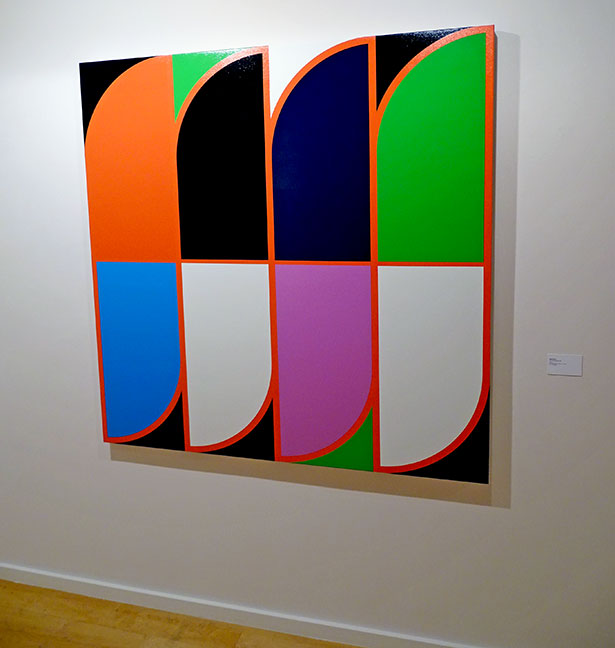
(art by Sarah Morris)

Current Features
- How to Buy Art on Instagram and Facebook
More and more people are buying more and more art online all the time, not only from artist websites or online stores, but perhaps even more so, on social media ... - Collect Art Like a Pro
In order to collect art intelligently, you have to master two basic skills. The first is being able to... - San Francisco Art Galleries >>